
Salt Lake County VINELink Coverage
The Utah Attorney General's VINE explanation describes a free, statewide cooperative service for custody information from participating Utah prisons and jails. That makes VINELink relevant to a person held by the Salt Lake County Sheriff and to a person in the Utah Department of Corrections system. Coverage depends on the custodian supplying data.
VINELink has two main roles. It can help a user search for one named offender, and it can deliver notices when a covered custody event changes. Utah sources identify release, transfer, and escape among the notice types. UDC also identifies specific state events such as death, movement among prison, county, and community-corrections locations, and a parole release date before release. County coverage should not be inflated into a promise that every UDC event appears for every jail record.
The statewide service is free and permits anonymous searching. Registration is needed for an online notification destination. The issuing custodian still controls the underlying record, so VINE should be treated as a notification layer rather than a certified Salt Lake County release report.
Search Salt Lake County VINELink Records
Use VINELink for a specific person, not as a browseable list of everyone recently released. Careful matching is essential because names can repeat and a person's custody can move between agencies. A result from one custodian says nothing final about another custodian.
- Open VINELink and choose Utah as the state.
- Select the Search tab, then choose Offender.
- Enter the person's name and any requested identifying details. Use an offender number when the service offers that route and the number is known.
- Compare possible matches carefully. Do not select a result based on the name alone when other identifiers differ.
- Open the matching record and read the named custodian, custody information, and event details together.
- If the event matters for pickup or a legal timeline, confirm it with the Sheriff, UDC, or Board.
For a broader custody-specific investigation, the Salt Lake County released inmate search routes county, state, court, federal, and immigration records separately. That sequence is useful when VINELink returns no result or shows only one part of a transfer.
The official VINELink interface provides the Utah search and registration controls used for this process.
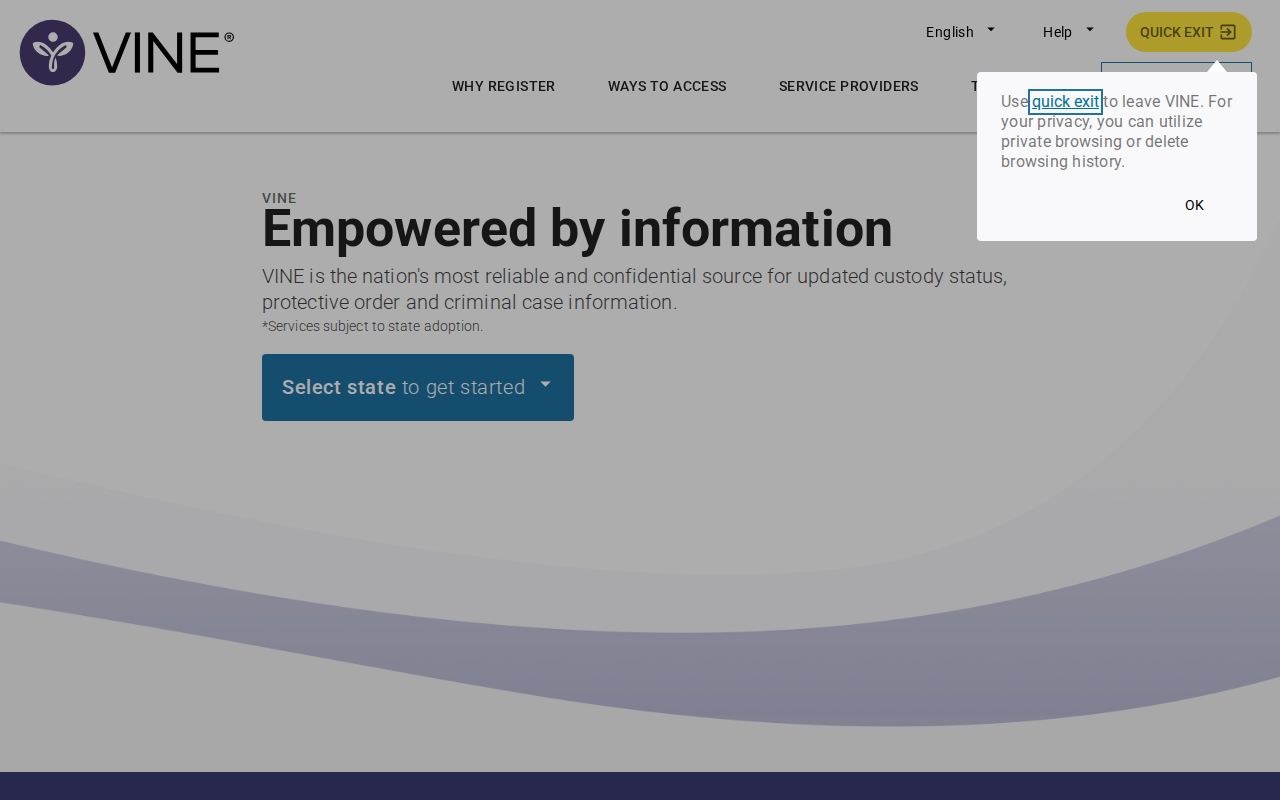
The interface keeps the offender search tied to a chosen state and places alert registration after the correct person has been identified.
Salt Lake County VINE Result Meaning
Utah's official descriptions support a limited field inventory. VINE can provide custody information and may show whether release-date information is available. No released person's record was opened merely to manufacture an example during research, so exact public result wording beyond the service descriptions is not promised.
| Result element | How to read it |
|---|---|
| Person and identifiers | Support matching the selected result; verify more than the name when possible. |
| Named custodian | Identifies the jail or prison source responsible for that custody event. |
| Custody information | Reflects information supplied by the participating custodian and may lag a new event. |
| Release-date information | May be available for a covered person; confirm whether it is notice of a future event or a completed release. |
| Notification option | Allows registration for supported changes after the correct person is located. |
“Released” is custodian-specific. If Salt Lake County sends someone to UDC, ICE, another jail, or federal custody, county custody can end while confinement continues. A VINE event should be read with the agency name and the next destination, then confirmed through the receiving system.
Note: A Salt Lake County jail roster absence does not prove release, and a VINE event does not replace the issuing agency's record.
Register Salt Lake County Release Alerts
Registration begins after the correct offender has been located. A user may create an online account or call the Utah VINE line at 877-884-8463. Utah sources support telephone and email destinations. Choose the notification channel that can be monitored, and keep the confirmation details secure.
- Open the matching offender record and choose the notification or registration option.
- Create an account online when prompted, or use the statewide telephone route.
- Select telephone and/or email and provide the requested destination.
- For a UDC telephone notice, choose a PIN that can be entered when the automated call arrives.
- Answer the call and enter the correct PIN to confirm receipt.
- Contact the custodian to verify a release, transfer, or date that requires action.
UDC says automated calls and emails can repeat each hour for up to 48 hours until the correct PIN confirms receipt. The same PIN may be used for more than one telephone registration. These are UDC workflow facts, not a guarantee that each participating county jail handles every event in the same way.
The UDC victim-notification page shows the supported events and the PIN confirmation process.
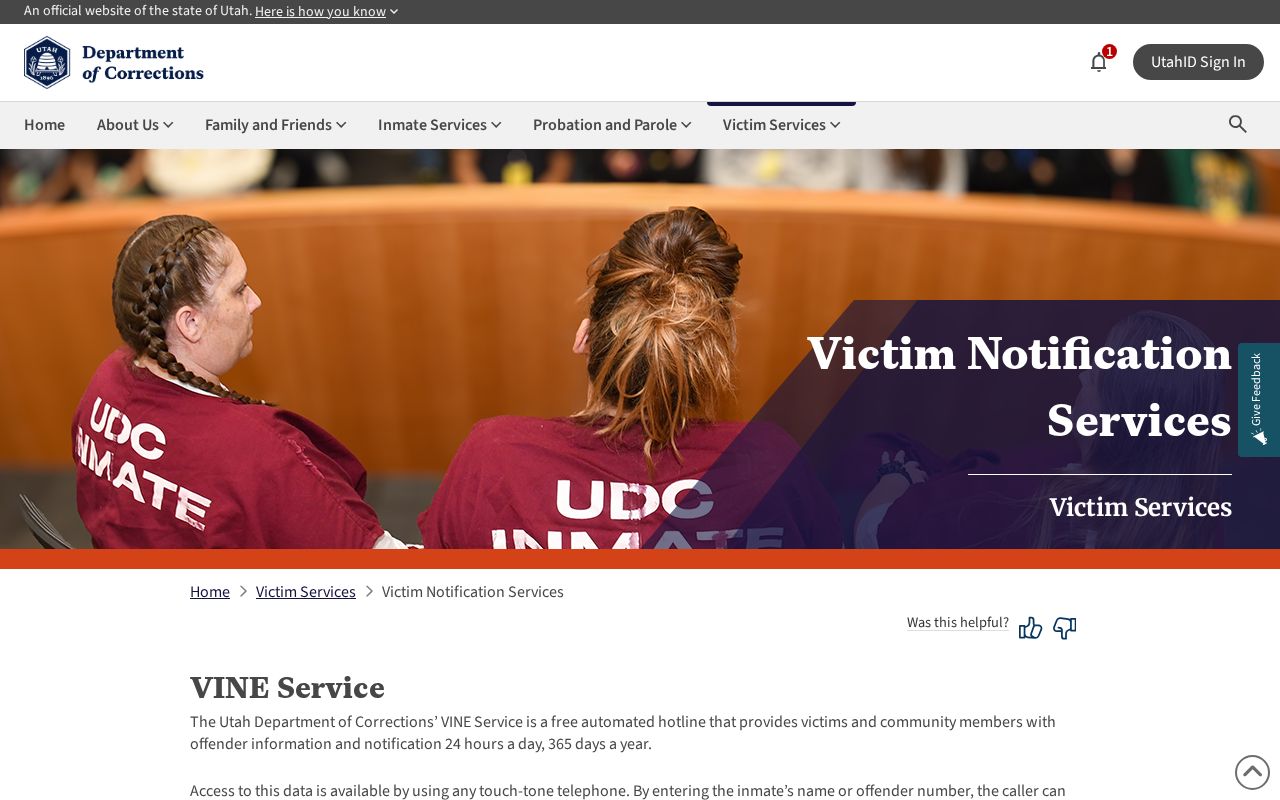
The repeated-notice design makes confirmation important, while agency verification remains necessary for exact release timing.
Confirm Salt Lake County VINE Alerts
The Utah Board of Pardons and Parole has warned that technical issues can make VINELink notices inaccurate or missing. That warning changes how a Salt Lake County release alert should be used. It is a prompt to check the source, not sole proof that a physical release occurred at a certain time.
For a Metro or Oxbow event, the newest Jail In/Out Docket is the first official movement source, and a Sheriff booking/release report can provide the actual time, authority, and destination. For a state prisoner or parolee, use the UDC Offender Search and read Location, placement, Release Date/Type, and case-manager information together. UDC limits that public search to people currently under its supervision.
A person who has completed all UDC supervision may disappear from that lookup. No result is not a discharge certificate. Board decisions, court records, and a UDC or Board records request are better sources for an older final discharge.
Utah VINE for Salt Lake County
Utah uses one statewide VINE layer across participating jails and prisons. This local setup avoids treating Salt Lake County jail custody and UDC prison custody as unrelated notification products. A user can search through the same statewide entry point, yet the event's named agency still controls what the notice means.
UDC's event set includes release, transfer, escape, death, a parole release date before release, and movements involving county jail, prison sites, or community corrections. That last category matters in Salt Lake County because four UDC community correctional centers operate locally. Movement from secure prison to a center can be a parole placement under continued supervision rather than unrestricted discharge.
The Board's warning adds a second local layer: even a statewide service can have technical gaps. The Board directs people who need verified updates to its telephone channel. For a county jail event, the Sheriff's issued record remains the final local source.
An alert also needs event context. A transfer notice may mark movement from the Salt Lake County jail to UDC, from secure prison to a community correctional center, or between UDC locations. None of those messages alone proves final discharge. A future parole date is also different from a completed physical release because the Board can later rescind an authorized date. Read the event label, custodian, and later agency status as a set.
Note: Registering for a notice does not change custody status and does not ensure that every participating agency supplies the same event detail.
Salt Lake County Custody Boundaries
A VINE result becomes clearer when the likely custodian is identified first. An unsentenced Salt Lake County detainee belongs in Sheriff and court records. A sentenced Utah prisoner belongs in UDC and Board records. A federal prisoner belongs in BOP or USMS records, and an immigration detainee belongs in ICE systems.
| Population | Primary confirmation | VINELink role |
|---|---|---|
| Metro or Oxbow detainee | Sheriff docket and booking/release report | Participating custody search and notice layer. |
| UDC prisoner or parolee | UDC detail plus Board record when relevant | State custody events and supported notifications. |
| Fully discharged state person | Board, court, or requested UDC record | May no longer have a current searchable UDC result. |
| Federal prisoner | BOP locator, federal docket, or USMS | Not the federal custody system. |
| Immigration detainee | ICE Online Detainee Locator | Does not replace ICE custody data. |
Following these boundaries prevents a blank VINE search from becoming a false release claim. It also prevents a Salt Lake County jail transfer from being mistaken for the end of all custody.
A county movement docket and a VINE alert may describe the same transition from different angles. The docket is the Sheriff's dated operational source. The alert is a message built from participating agency data. If one appears before the other, do not force the timestamps to match. Save the event details, identify the source agency, and ask that agency to reconcile a conflict. This is especially important when a pickup, court filing, or supervision appointment depends on the event being complete.
Federal Limits on VINELink Checks
VINELink is not the Bureau of Prisons locator. For a sentenced federal prisoner, the BOP Inmate Locator can show a past release date and no current location. That confirms the BOP custody event ended, but it does not answer whether court-ordered supervision or another agency's custody continues.
Federal pretrial custody may be handled through the federal docket and USMS rather than BOP. ICE also has a distinct locator that covers current detainees and certain people recently released from ICE custody. If the Salt Lake County Sheriff recorded a handoff to either system, follow the receiving custodian instead of waiting for a VINE notice that the system is not designed to provide.