
Salt Lake County's Daily Release Source
The Salt Lake County Sheriff's Office publishes daily Jail In/Out Docket PDFs through its official docket and roster page. It does not label any page as a rolling list of people released during the prior 24 hours. The newest docket is the closest official online equivalent. Its date identifies one calendar day's jail movements, so it should not be described as a live, hour-by-hour feed.
The same interface also offers a Roster PDF. That document is a daily bed snapshot, not a release archive. A name on the Roster points toward custody at the snapshot time. A name missing from it does not prove release because the person may have transferred, moved before the snapshot, or fallen outside the data timing. Quick book-and-release cases may also be absent from the Sheriff's daily Dashboard.
Check Salt Lake County 24-Hour Releases
Start with the date, not the current Roster. Salt Lake County posts one docket for a calendar day, while a true rolling window would constantly move forward. If the expected event occurred near midnight, the closest practical check may need both the newest docket and the adjacent day's file. The source does not promise an instant update.
- Open the Sheriff's docket and roster page and select the newest Jail In/Out Docket, not the Roster.
- Confirm the date shown for the PDF. Add the prior or next day's docket when the event was close to a date boundary.
- Use the PDF viewer's find tool to search the person's exact name. Check spelling and any known alias.
- Read the entry as a movement from Salt Lake County custody. Do not assume that an exit means community release.
- Compare the current Roster only to check whether the person appears in the latest bed snapshot.
- When the destination or authority matters, request the booking/release report from the Sheriff.
A named-person investigation may need several systems after the docket check. The Salt Lake County released inmate search path explains when to use court, UDC, VINE, federal, or immigration records. Those systems answer different custody questions and should not be blended into one result.
What Salt Lake County Release Files Show
The official interface establishes the product name, file date, file type, and a link to each PDF. Those are verified interface facts. The research environment could not reliably extract the latest docket's internal columns, so no release time, reason, destination, booking number, photograph, or facility column is promised here. Readers should use only labels visible in the PDF they open.
| Verified interface item | What it means |
|---|---|
| Jail In/Out Docket | The release-oriented daily movement product published by the Sheriff. |
| Calendar date | The date assigned to that day's document, not a rolling prior-24-hours filter. |
| File type | Distinguishes the movement docket from the separate current Roster. |
| PDF link | Opens the official dated document that must be searched and read directly. |
| Published file listing | Shows which dated files are currently exposed online, not the County's legal retention period. |
The official file-list endpoint shows the dated docket and roster entries behind the interface. The captured view below documents the files available during research. It does not promise that the same dates or archive depth will remain online.
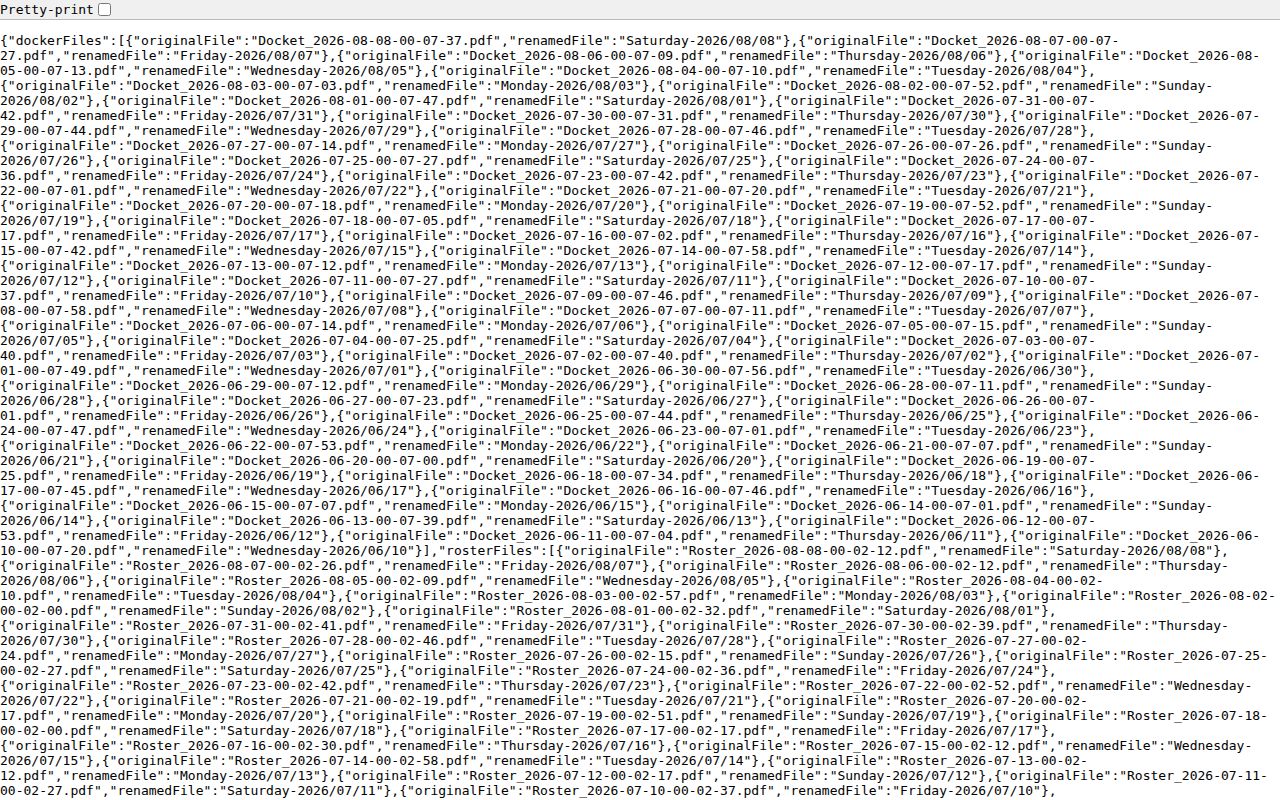
The separate docket and roster entries reinforce the key distinction: one tracks daily jail movement, while the other reports a daily custody snapshot.
Note: Transcribe fields from the current PDF itself because the Sheriff's interface can change without creating a new page or URL.
Salt Lake County Release Record Fallbacks
A dated docket may age off the public list, and a newly completed event may not appear at once. The observed archive held about 60 dates on the research date, but Salt Lake County does not call that a retention rule. Older official records may still exist even when the online interface no longer links them. A focused GRAMA request is the strongest county fallback.
Ask the Sheriff for existing booking and release records tied to the person's full legal name, aliases, SO number if known, approximate booking date, and court case number. Request the actual release date and time, release authority or disposition, and destination or receiving agency. The request should seek records, not ask the agency to make a legal conclusion. The Salt Lake County NextRequest portal provides a written submission path.
VINELink can send a notice about a participating custody event, and a court record can explain the order or disposition behind an exit. UDC is the right follow-up only when the person entered Utah state custody or remains under state supervision. BOP and ICE have their own systems. The Sheriff's general jail line cannot replace the formal route because the Corrections FAQ says staff do not disclose release dates.
If a single daily file does not cover the expected event, use the Salt Lake County 72-Hour Release List method to search three dated dockets and an adjacent file when needed.
Salt Lake County Release or Transfer
Salt Lake County records must be read by custodian. Bond, dismissal, a judge's order, completed county time, or probation can lead to community release. An outgoing movement to the Utah Department of Corrections, ICE, another jail, or federal custody ends the Sheriff's hold but continues custody elsewhere. A community correctional center can also be a structured UDC placement rather than final discharge.
| Situation | Best next check | What it can establish |
|---|---|---|
| Still shown on current Roster | Salt Lake County Roster | Presence in the daily jail-bed snapshot. |
| Outgoing county movement | In/Out Docket and Sheriff release report | End of that jail event and, in a full report, the authority or destination. |
| Transfer to UDC | UDC Offender Search | Current state location, placement, and supervision details when covered. |
| Release to ICE | ICE detainee locator | Current or certain recent ICE custody records, not a complete outcome history. |
| Community release | Sheriff report plus court case | The physical custody event and the legal order or disposition. |
A blank Roster result is weak evidence. A full Sheriff record, read with the receiving agency or court source, is far more reliable.
When Salt Lake County Releases Occur
Salt Lake County's Behavioral Health and Justice Action Plan says jail releases occur at all hours. The Sheriff also says a person receives free local calls shortly before release, while staff will not disclose the release date to callers. There is no dependable public pickup schedule to substitute for the dated docket or a VINE alert.
This timing makes pickup event-driven. The person in custody should use the pre-release call when possible, and the person waiting should avoid treating an expected court outcome as proof that all jail processing is complete. Another hold can keep someone in custody even after bail has been paid or a release route has been authorized.
Note: The Sheriff's pre-release call is the practical pickup signal, while the release report is the source for exact recorded timing.
Home After Salt Lake County State Release
Utah state-prison release has a separate Salt Lake County process. UDC ordinarily handles releases and paroles at the Utah State Correctional Facility on Tuesday, including almost all UDC inmates temporarily housed in county jails. People assigned to a community correctional center are transported there by UDC. Those without a ride may be taken case by case to a nearby UTA TRAX station and are released last.
These facts do not describe routine Metro or Oxbow releases. They matter only when the Salt Lake County outgoing event leads into UDC's state process. A county docket movement can occur before the later state release is complete, so family transportation plans should follow the actual custodian rather than the county docket alone.
Salt Lake County Bail Release Routes
Metro accepts bail around the clock, and the Sheriff does not add a county payment fee. Payment still does not guarantee an immediate exit. Processing or another hold may remain. County Pretrial also offers qualifying nonfinancial release, while the Surrender Program can schedule a qualifying warrant defendant for arraignment, booking, and immediate release to pretrial.
These routes are legally distinct from time served, dismissal, or transfer. The daily docket may point to movement, but the formal release report and court record supply the sound basis for identifying why it occurred. Exact source wording matters.
A bond receipt confirms payment, not the end of jail processing. Check the later movement and any remaining hold before arranging the final pickup.