
USCF Release Destinations
A USCF release ends secure prison custody at that facility, but it may begin another stage. UDC can release a person to community parole, transport the person to Atherton, Bonneville, Fortitude, or Orange Street, or process a sentence expiration. Parole is supervised release before the full sentence is complete. A community correctional center is a controlled residential placement, not unrestricted discharge.
Read the destination with the legal action. A Board order may authorize parole on a future effective date. That order can be rescinded before physical release, so it should be paired with the UDC detail after the date. Location, Housing Facility, Release Date/Type, and case-manager information can show that secure custody ended while UDC supervision continues.
Search USCF Release Records
The UDC Offender Search accepts first and last name, an optional middle name, or a UDC number. Name results show the offender number, name, date of birth, and a route to more information. The detail is the useful release view. Its scope is limited to people currently under UDC supervision, including prison, probation, and parole.
- Search by UDC number when known, or match the full name and date of birth.
- Open More Information and read Location and Housing Facility together.
- Record the exact public field called Release Date/Type without renaming it projected.
- Check the Board's person search for the decision, effective date, and order PDF.
- Confirm continuing placement with the listed case manager or Region 3 AP&P.
- Request UDC or Board records if a fully discharged person no longer appears.
A no-result response does not certify discharge. UDC expressly limits the search to current supervision. Previous Board decisions, court history, and a formal request are the older-release fallbacks. The Salt Lake County released inmate lookup helps when it is unclear whether the person was in county or state custody.
USCF Release Record Fields
Each public field answers a narrow question. Location and housing can separate a secure unit, community center, or community supervision. Release Date/Type supplies UDC's own combined label. A case manager points to ongoing supervision. None of those fields alone is a final-discharge certificate.
| Field | What it supports |
|---|---|
| UDC number and name | Identity match |
| Location | Current UDC placement category |
| Housing Facility | Secure or structured site detail |
| Release Date/Type | UDC's stated release entry |
| Case manager | Continuing supervision contact |
| Board order | Decision and effective date |
Utah uses indeterminate sentencing. The court commonly imposes a statutory range, while the Board decides actual prison duration and parole action within legal limits. Guidelines inform the process but do not create a fixed promise. Misconduct, a new conviction, an unresolved release condition, or a rescission action can change a planned date.
Note: Utah's verified public field is Release Date/Type; the UDC interface does not show a separate tentative or projected field.
Tuesday USCF Release Processing
UDC says releases and paroles are processed each Tuesday at USCF. Almost all UDC inmates temporarily housed in county jails also pass through this state process. Direct UDC release from a county jail is described as extremely rare. A Salt Lake County outgoing docket can therefore mark movement toward USCF before the later state release is finished.
Family or support people meeting a person from USCF or Central Utah Correctional Facility are told to arrive at 9 a.m. Those meeting a UDC inmate housed in a county jail are told to arrive at 10 a.m. These are official release-day instructions, not a guarantee of an individual's exit. UDC transports people assigned to a community correctional center directly. A person without a ride may receive case-by-case transport to a nearby UTA TRAX station and is released last.
The official UDC release-day instructions show how Tuesday processing differs from Metro or Oxbow bond release. That distinction prevents a county roster disappearance from being mistaken for completed state release.
USCF Records and Contact
Contact USCF for facility information and UDC or the Board for formal release records. A focused state request should include the UDC number, conviction or case, approximate dates, Board order, actual physical release date, release type and destination, AP&P or community-center placement, and final supervision-termination date. Asking for both physical release and final discharge prevents two different milestones from being collapsed.
Utah State Correctional Facility
1480 North 8000 West
Salt Lake City, UT 84116
Facility: 801-522-7000
Information line: Call for current information
The Board's searchable previous decisions and order PDFs may answer the legal-action question without a new request. When exact completion matters, the issuing UDC record is stronger than a VINE alert or a family estimate. Utah VINE remains useful for release and transfer notices, though technical warnings make agency confirmation necessary.
Inside Utah State Correctional Facility
USCF began operations in July 2022 and has a stated capacity of 3,600. UDC identifies Antelope, Bear, Currant, Dell, Emerald, Fremont, and Green buildings. These units are part of a state prison. They should never be described as Salt Lake County jail housing or searched through the Sheriff's county roster.
The official USCF facility page is captured in the matching research image below.
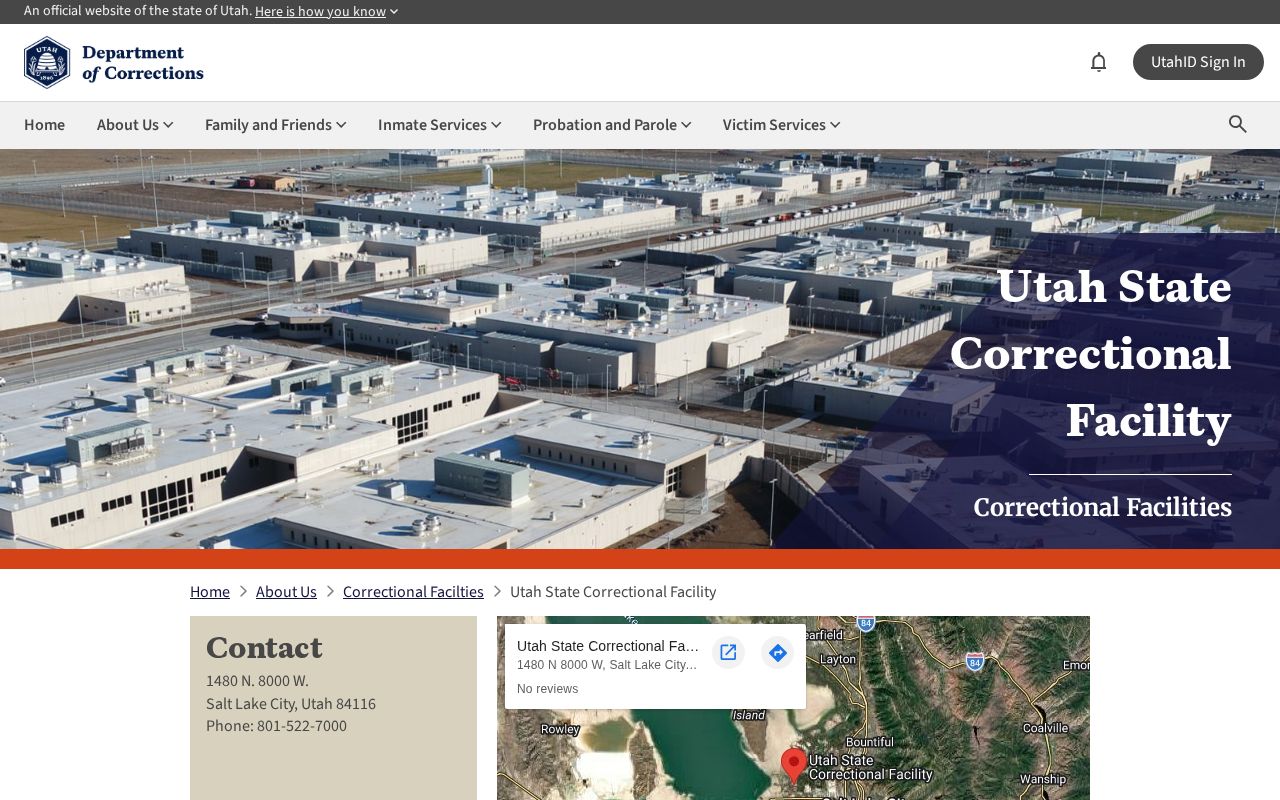
The image identifies the state facility context that governs these releases, while the person-specific UDC and Board records establish an individual's result.
USCF Property After Release
UDC has a separate appointment-based property process. Property pickup is available Monday through Friday, excluding holidays, during 7 to 9 a.m., 11 a.m. to 1 p.m., and 3 to 5 p.m. Identification is required. The property numbers are 801-522-7771 and 801-522-7772.
This is not the Salt Lake County Sheriff's third-party property procedure. It also should not be treated as proof of a release date. Use the property channel for the property task and the UDC or Board record for release status. Keeping those functions separate avoids assuming that an appointment marks final discharge.
USCF Final Discharge Proof
A parolee may remain visible in UDC because supervision continues after secure release. A person who completes all supervision may disappear from the active-only search. In that case, previous Board decisions, the criminal court history, and formal UDC or Board records are the durable routes. Ask specifically for the date prison custody ended and the later date parole or probation terminated.
That distinction can affect legal timelines. Utah Courts measures some expungement waiting periods from the latest of case completion, jail or prison release, or end of probation or parole. A parole-release order may establish only the start of community supervision. It does not necessarily establish the later discharge date.
- Parole
- Conditional community release from prison under Board and AP&P authority.
- Community center
- A structured UDC residential placement during supervision.
- Expiration
- Completion of the custodial sentence as recorded by the responsible authority.
- Final discharge
- Termination of remaining UDC supervision, which may occur after physical release.
USCF Board Release Authority
The Utah Board of Pardons and Parole provides a person and date search for hearings and decisions. Results may contain upcoming hearings and previous decisions. Detail can identify hearing type, final decision date, description, effective date, and an order PDF. Use the actual wording because an original hearing, rehearing, violation hearing, rescission, or paper review does not carry the same meaning.
Utah uses indeterminate sentencing. The court's terms frame the case, while Board action controls whether parole occurs before expiration. Guidelines are recommendations, not a guaranteed exit date. Conduct, case-plan work, risk, victim information, the release plan, new matters, and unresolved conditions may affect the result.
A future date needs operational confirmation. Later action may change it before physical release. Compare the order with the UDC detail after the effective date, then use AP&P or a formal record to establish the destination. This matters when the destination is a Salt Lake County community correctional center, since that placement continues structured supervision.
USCF Earned-Time Records
Utah has no verified rule that every state prisoner serves one fixed percentage. It uses indeterminate sentences and Board-administered earned time. Under the program effective in July 2026, eligible completion of each of up to two approved Case Action Plan programs earns at least four months, and the Board may grant added discretionary credit. Exclusions and forfeiture rules apply.
Earned time may explain a changed Board date, but it does not replace the release record. Credit may be unavailable when too little time remains, no release date exists, a contingency is unmet, or another exclusion applies. A rescission process can also affect credit. Use the Board order, UDC status, and release record rather than estimating from program completion.