
Atherton Release Means Transition
Atherton is not a county jail and is not an ordinary bond-out destination. It serves men on probation or parole in a residential treatment setting. A person may arrive after release from secure prison, through a supervision placement, or as part of a response to supervision needs. Residence at Atherton can show that prison custody ended while structured UDC control continued.
Departure also needs careful wording. A move to an approved community setting may leave probation or parole in force. A return to prison or another center is a transfer. Final discharge occurs only when the responsible UDC or Board record shows supervision ended. The address alone cannot answer those questions.
Verify an Atherton Departure
Use the UDC Offender Search for a person who may still be supervised. The search accepts a UDC number or a first and last name, with middle name optional. Open the detailed record rather than relying on the results list.
- Match the UDC number, full name, and date of birth.
- Read Location and the facility field for the current placement.
- Read the exact Release Date/Type entry without treating it as final discharge.
- Use the listed case manager to clarify a current community assignment.
- Check Board decisions when the move followed prison parole.
- Request UDC records if the person completed supervision and vanished from the active search.
UDC limits its public search to people currently under its supervision. No result may mean supervision ended, but it does not prove that fact. The Board order, court history, and a formal UDC record are better historical evidence.
Atherton Records and Contact
The facility information line can address Atherton operations. Person-specific release and supervision questions belong with the UDC record, listed case manager, or Adult Probation and Parole. The research did not establish public lobby hours, so no hours should be inferred.
Atherton Community Treatment Center
2588 West 2365 South
West Valley City, UT 84119
Information:
801-978-4500
Hours: Call the information
line
A focused state request should identify the person and UDC number, the Atherton placement, approximate dates, any Board order, the actual departure date, the next placement, and final supervision-termination date if relevant. Asking for both departure and discharge prevents a residential move from being mistaken for completion of the whole sentence.
Note: The case manager or Region 3 AP&P can clarify current supervision when the public location label is not enough.
Atherton UDC Record Fields
The UDC detail gives several related facts. Location and the facility field describe the operational setting. Release Date/Type reflects UDC's public release label. Case-manager information points to continuing supervision. Read them as a group.
| Record item | Meaning at Atherton |
|---|---|
| Location | Current UDC placement category |
| Facility placement | May identify Atherton or a later site |
| Release Date/Type | Recorded release action, not certain final discharge |
| Case manager | Current supervision contact |
| Board order | Parole authority and effective date |
A Board order can authorize future parole, but the date may be rescinded before release. For that reason, pair the order with a post-effective-date UDC record. VINE may send a move or release notice, yet it remains a notification source and should be confirmed.
Atherton's Treatment Placement Role
The official UDC community correctional centers overview places Atherton within Salt Lake County's structured reentry network.
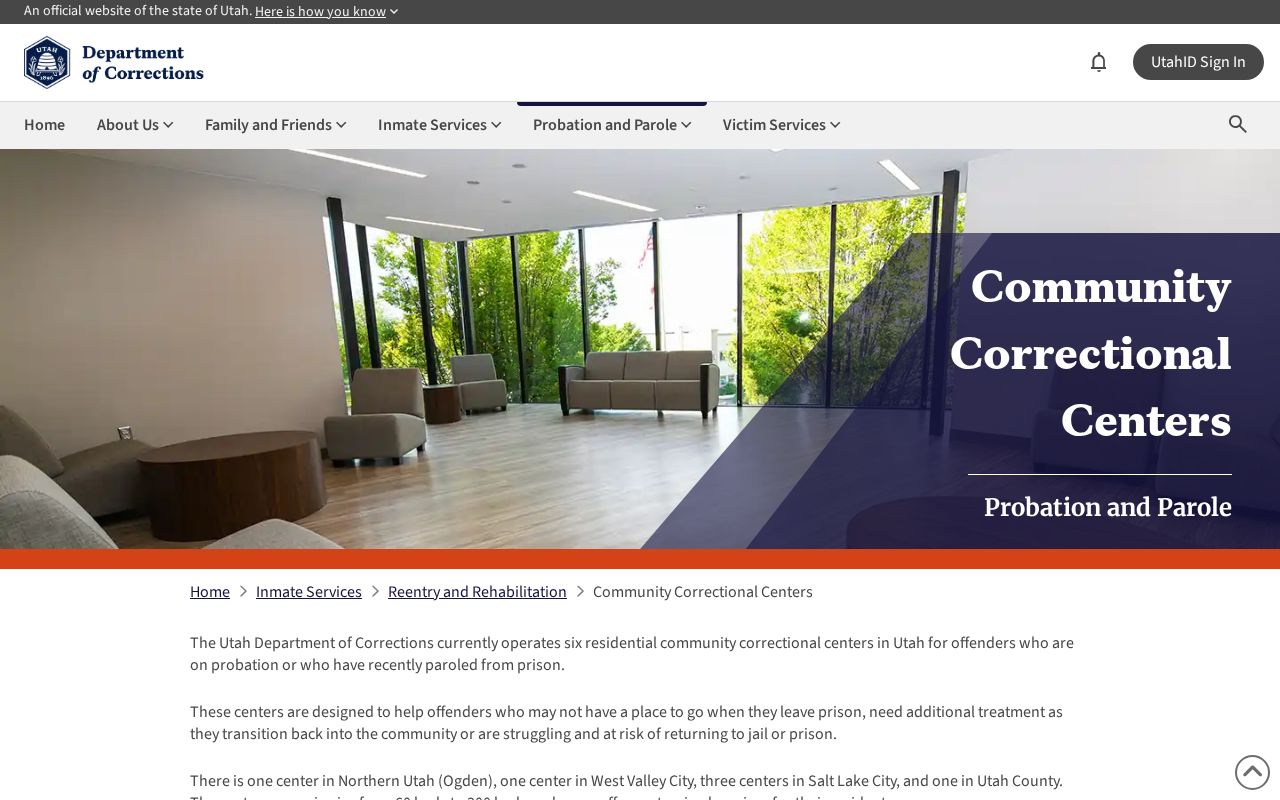
The image supports the facility's state community-corrections role, while an individual UDC record is still needed to verify any person's departure or discharge.
Atherton's documented population makes it distinct from the other local centers. It serves men on probation or parole who have mental-health concerns. That program description should not be used to infer a diagnosis for any named resident. Only an appropriate agency record can establish an individual's status, and protected health information may not be public.
After an Atherton Release
A move onward may mean ordinary community supervision continues under AP&P. Region 3 serves Salt Lake, Summit, and Tooele counties. The public UDC detail may show a community location and case manager after Atherton. That is evidence of ongoing oversight, not the end of the sentence.
If Atherton departure instead led to another center or secure prison, confirm the new facility placement. If the person completed all supervision, obtain the final termination record because active-only UDC search results may disappear. The Salt Lake County parole and probation page explains the Region 3 verification path.
- Probation
- Court-ordered community supervision that may include residential placement.
- Parole
- Board-authorized release from prison under supervision.
- Placement
- The assigned residence or facility within a supervision plan.
- Discharge
- The formal end of supervision, not merely a change of address.
Atherton Historical Release Proof
For a past resident who no longer appears in UDC, search the Board's previous decisions when parole was involved and review the related court case. A prior Board order can show the authorized action. It cannot by itself prove the exact physical departure or later end of supervision.
Request existing UDC or Board records for the actual move from secure prison, Atherton admission and departure, next placement, and final discharge. Where records conflict, the agency that created the specific field should correct it. A Salt Lake County Sheriff docket is relevant only if an earlier county-jail movement fed into UDC. It is not the Atherton release archive.
Atherton Release Evidence Order
When a Board order and UDC status conflict, an order may set a future date that later action can change. Check the detail after the effective date and ask the case manager about the current assignment. If the person was on probation rather than parole, the court order supplies the legal basis while UDC and AP&P show how residential placement was managed.
A reliable sequence is the court or Board action, UDC placement entry, Atherton departure record, and later supervision or discharge record. VINE can add notice of a move, but it does not replace that chain. This order preserves Atherton's role without turning protected program details into claims about a resident.
Atherton Mental-Health Placement Records
UDC describes Atherton as serving men on probation or parole who have mental-health concerns. That fact defines the program population, not a diagnosis for a named resident. Public placement data should be used only to identify the responsible UDC channel and determine whether structured supervision continues. It does not justify an inference about treatment, symptoms, or private clinical records.
A useful Atherton status record therefore stays narrow. It can identify admission to the center, departure, the next UDC placement, the supervising case manager, and final termination if that later event occurred. The reason for treatment and protected care details may not be public. Ask the agency for existing release and placement fields instead of a clinical narrative.
This limit also protects accuracy. Men may reach Atherton while on probation or parole, which are different legal routes. Probation comes from a court order. Parole follows a Board decision releasing a person from prison under conditions. Read the court or Board source before describing how the Atherton placement began.
Atherton AP&P Status Confirmation
Adult Probation and Parole is the operational source when a man leaves Atherton but remains supervised. Region 3 serves Salt Lake, Summit, and Tooele counties from 36 West Fremont Avenue in Salt Lake City. Its published telephone number is 801-239-2100, while UDC lists 801-545-5908 for the AP&P division.
Start with the case manager shown in the UDC detail because that field ties the question to the person's current assignment. Ask whether Atherton residence ended, whether another center or community placement followed, and whether supervision remains active. Do not label a person discharged merely because the old facility name changed.
AP&P also documents warrant and fugitive work when someone absconds. No complete public Utah absconder list was verified in the research. An old notice, missed appointment, or stale location must not be converted into a current status claim. Confirm any such issue with AP&P or the responsible warrant authority.
Note: Atherton departure, current AP&P assignment, and final discharge are three separate facts that may carry different dates.
Atherton Departure Record Sequence
Build an older Atherton history in event order. A Board or court record establishes the legal supervision route. UDC documents the secure-prison release when one occurred, the Atherton placement, and the next reported location. AP&P supplies the continuing community assignment, while a termination record proves the later end of supervision.
UDC's public search covers only people currently under its supervision. A fully discharged person may no longer appear, so a blank search is not proof of when Atherton residence or supervision ended. Request the UDC or Board record using the UDC number, approximate dates, related case, departure destination, and final termination date.
If a Salt Lake County jail movement preceded the state placement, the Sheriff docket proves only that earlier county event. Almost all UDC inmates temporarily held in county jails pass through Tuesday release processing at USCF. UDC then transports people assigned to a community correctional center. Keep that state sequence distinct from a routine Metro or Oxbow community release.