
Salt Lake County Release Meaning
“Released” describes the end of one agency's custody event. It does not always mean a person entered the community. The Salt Lake County Sheriff's Office may record an exit from Metro Jail or Oxbow because of bond, a court order, dismissal, sentence completion, probation, or a handoff. A transfer to the Utah Department of Corrections, ICE, another jail, or a federal custodian ends county custody while a new form of custody begins. Death also closes a custody event, but it is not an ordinary release and should never be described that way.
The issuing record must answer four points: who held the person, when that custody ended, what authority caused the exit, and where the person went next. The daily Jail In/Out Docket is the first official movement source for a recent county event. A full booking and release report can add the exact time, release authority, case identifiers, and receiving agency. The live Roster answers a different question. It identifies people in a jail-bed snapshot, not the people who previously left custody.
A missing roster name is not release proof. Confirm the outgoing movement and destination through the Sheriff, court, UDC, VINE, BOP, or ICE as the event requires.
Salt Lake County Release Routes
Each Salt Lake County release route points to a different next record. Bond and a judge's release order can send a county detainee into the community, subject to any other hold. A county sentence may end through time served. Probation is court-ordered community supervision and may follow jail time. State parole begins when the Utah Board of Pardons and Parole authorizes release from prison under conditions. Transfers require the most care because the word “out” can refer only to the county facility.
| Release route | Meaning | Best next source |
|---|---|---|
| Bond or court order | County jail custody may end after processing if no other hold applies. | Sheriff release report and court case |
| Time served or dismissal | The local custody basis may be complete or removed. | Sheriff report, docket, and Xchange |
| Probation | The person is outside jail under a court supervision order. | UDC active-supervision search and court file |
| State parole | Secure prison custody ends while UDC supervision continues. | Board order, UDC record, and AP&P |
| Agency transfer | County custody ends, but another custodian receives the person. | Receiving agency plus Sheriff destination field |
- Discharge
- The end of a custody or supervision obligation, as stated by the responsible agency.
- Time served
- A sentence outcome crediting confinement already completed.
- Detainer
- A request or hold that can prevent community release or cause a transfer.
- Expungement
- A court process that restricts public case visibility when legal requirements are met.
Salt Lake Release Record Fields
A useful Salt Lake County release record keeps identity, timing, legal authority, and destination separate. Name, date of birth, SO number, UDC number, court number, or federal number helps match the person. A booking date shows entry into one system. It is not an exit date. The release date and time show when that custodian ended the event, while the authority or type can distinguish bond, sentence completion, parole, transfer, or another result.
| Field | What it establishes |
|---|---|
| Name and agency number | Connects the person to the correct agency record; match another identifier when names are alike. |
| Booking or admission | Shows when the custody event began and which facility received the person. |
| Release date and time | Shows when the named custodian ended that event, not whether all custody ended. |
| Release authority or type | Records the source's reason, such as bond, order, parole, completion, or transfer. |
| Destination or receiving agency | Separates community release from UDC, ICE, federal, hospital, or jail transfer. |
| Charge and case number | Links the jail event to the court record that can remain after a roster changes. |
| Supervision details | Can show a UDC location, case manager, or continuing parole or probation status. |
The UDC public field is labeled Release Date/Type. It should be read with Location, Housing Facility, and case-manager data. A Board decision can authorize a future date, but a later rescission may change it. Court entries can preserve the legal disposition. They do not automatically show the exact moment a person left a facility.
Request Salt Lake Release Records
When an online docket has aged off or lacks a clear destination, request the existing booking and release records from the Salt Lake County Sheriff's Office. The county NextRequest portal and the written Sheriff GRAMA form are the official written routes. Name the agency and describe the existing record with enough detail to locate it. Utah law does not require an office to create a custom summary that it does not maintain.
- Give the full legal name, known aliases, date of birth when appropriate, and SO number if known.
- Identify the approximate booking date, facility, and court case number.
- Ask for the booking/release report, actual release date and time, authority or disposition, and destination or receiving agency.
- Choose inspection or copies, accept stated duplication costs if needed, and request a fee waiver only when it applies.
- Provide photo identification before records are released and respond if the office needs clarification.
The county GRAMA guide gives the first 30 minutes of staff time without charge. Added staff time is $25 per hour. Paper copies may cost up to $0.50 per page, certified copies may cost $10 or the governing statutory amount, and prepayment can be required if the estimate exceeds $50. An ordinary response is generally due within ten business days. Extraordinary circumstances can extend that time with notice.
The official county process and fee page shows how the request moves from submission to response.
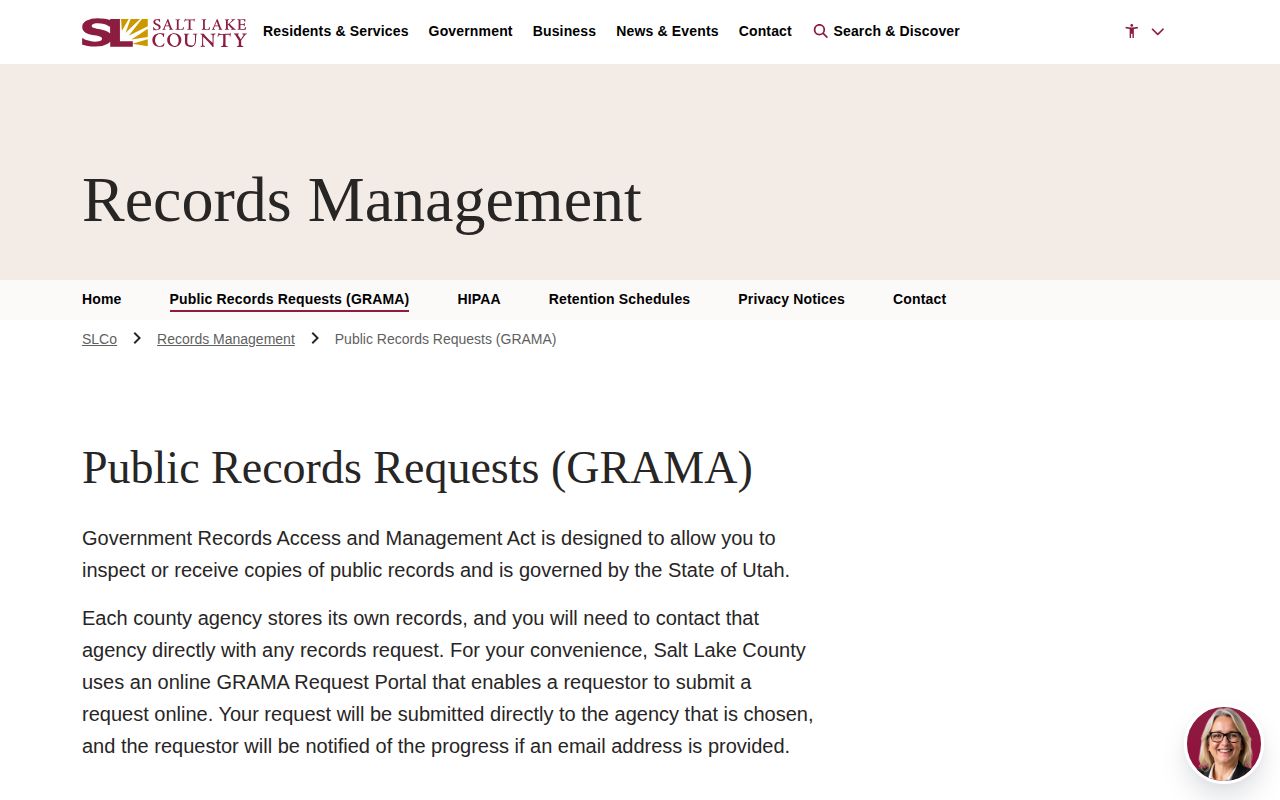
The screenshot supports the written request route when a release record no longer appears in the daily online files.
Note: Inspection of public portions is free, but copies, staff work beyond the free period, and certification can carry lawful charges.
Utah Release Record Law
Utah Code §63G-2-201 begins with access to public government records unless another classification restricts them. Section 63G-2-204 sets the ordinary and qualifying expedited response periods and requires a grant, a reasoned denial with appeal information, a statement that no record exists, or an extraordinary-circumstance estimate. Juvenile, sealed, expunged, and other protected material remains outside normal public access.
Online availability and agency retention are not the same. On the research date, the Sheriff file interface exposed about 60 dated dockets and roughly the same number of rosters. That was an observed window, not a legal retention promise. A record may remain with the government after its link disappears. For that reason, an older Salt Lake County release should move to GRAMA, the court clerk, UDC, the Board, or the relevant federal agency instead of being treated as unknowable.
Salt Lake Release Calls
Salt Lake County reports that jail releases can occur at all hours. The Sheriff also says a person receives free local calls about 15 to 30 minutes before release so pickup can be arranged. Staff will not disclose a prisoner's release date to callers. These rules make release pickup event-driven. A family should not rely on a fixed public exit schedule that the Sheriff does not publish.
The Corrections Bureau information explains both the call and the release-date policy. The dated movement docket and VINE notice are more useful for tracking the event, while the final booking/release report is stronger evidence. The County Action Plan recommends better coordination, transport, treatment links, and medication continuity, but those recommendations are not a promise that each person receives those services.
Salt Lake Bond Release
Metro Jail accepts bail around the clock in cash, cashier's check, or certified check at the Visiting Lobby. The Sheriff charges no bail-payment fee, although check verification occurs during stated business hours. Payment alone does not guarantee a quick exit. Another hold, another case, or ordinary processing can keep the person in custody after funds are accepted.
The official bail payment page shows the accepted methods and the need for the SO number. County Pretrial Services offers nonfinancial monitoring and case management for qualifying cases, with the court making the release decision. The separate Surrender Program can screen and schedule some people with warrants for arraignment, booking, and immediate release to pretrial. These are legal release paths, not a general guarantee.
The county bail page also illustrates why payment status and physical release are not the same fact.
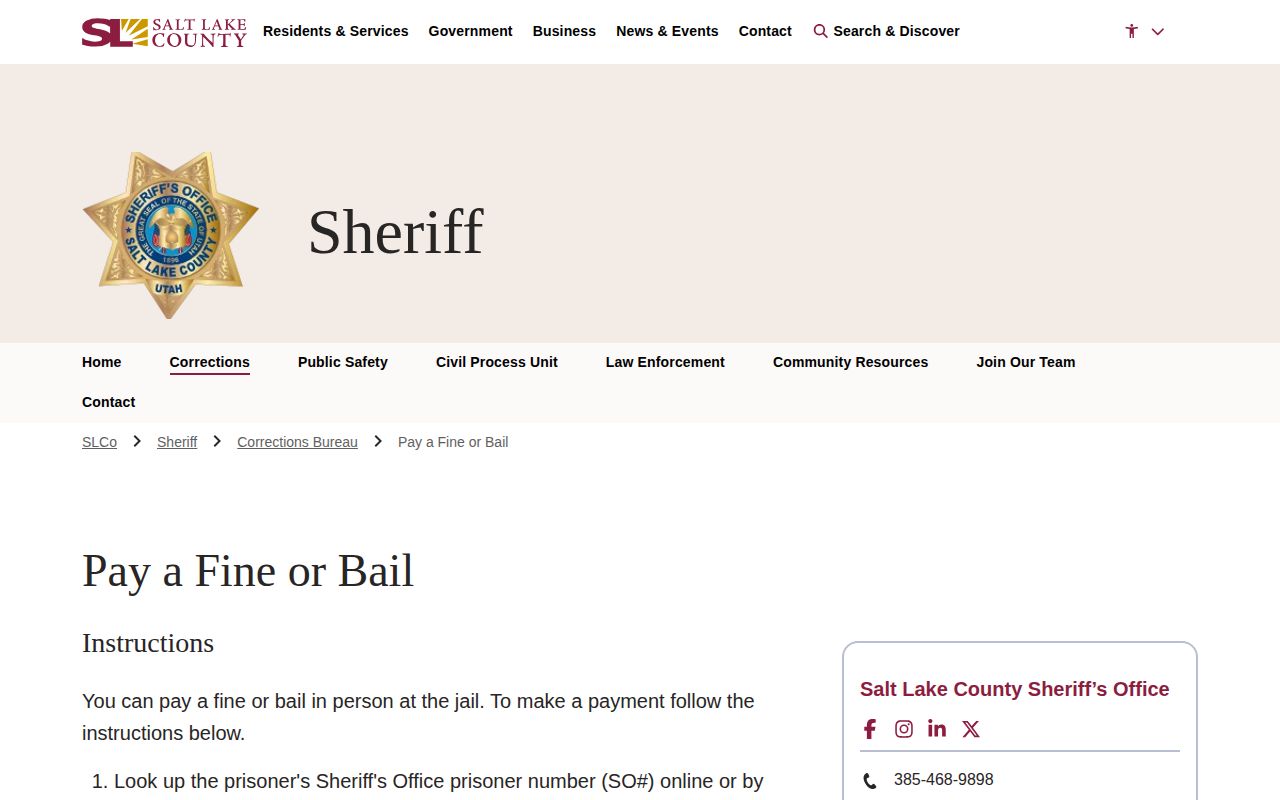
The displayed rules reinforce the need to check holds and completed processing after bail is paid.
Salt Lake Release Statistics
A 2024 county fact sheet reported about 36,000 bookings per year, with 70% described as repeat offenders, and a combined jail capacity then listed at 2,455 beds. These are booking and capacity measures. They are not a count of unique people or community releases. A person can have more than one booking, and an outgoing movement can lead to another custodian.
The Sheriff Jail Dashboard is also a daily bed snapshot. Its own explanation says quick book-and-release events may not be captured. Neither the annual booking figure nor the daily bed count should be converted into an unsupported total for Salt Lake County released inmates.
Find Salt Lake County Releases
Start with the likely custodian, not a single universal search. A recent Metro or Oxbow event belongs in the Sheriff's dated Jail In/Out Docket. A sentenced state prisoner belongs in UDC and Board records. A federal prisoner belongs in BOP records, while an immigration transfer belongs in ICE systems. Court records can explain the legal result, and VINE can send status notices, but the issuing agency remains the best source for an exact completed release.
- Identify whether the event began in county jail, state prison, federal custody, or immigration custody.
- For county jail, search the latest dated In/Out Docket and use the current Roster only to check present bed status.
- Resolve the destination through the docket, court file, or Sheriff booking/release report.
- For state custody, search UDC and the Board; read location, housing, release type, and supervision together.
- Use VINE for notices, Xchange for court disposition, and BOP or ICE only for the populations they cover.
- Request the agency record when the date is old, the result is blank, or two systems conflict.
The Salt Lake County 24-hour release list method uses the newest daily docket for same-day movement. It does not turn the live Roster into a release list.
Salt Lake Daily Release Docket
Salt Lake County does not publish a separately labeled rolling 24-hour or 72-hour release feed. It posts a dated Jail In/Out Docket and a separate daily Roster. For a same-day equivalent, open the newest movement docket. For a three-day check, search the latest three dockets and consider an adjacent date near midnight, a weekend, or a holiday. The Sheriff does not guarantee the observed posting cadence or online archive length.
The official roster and docket interface makes the two products distinct.
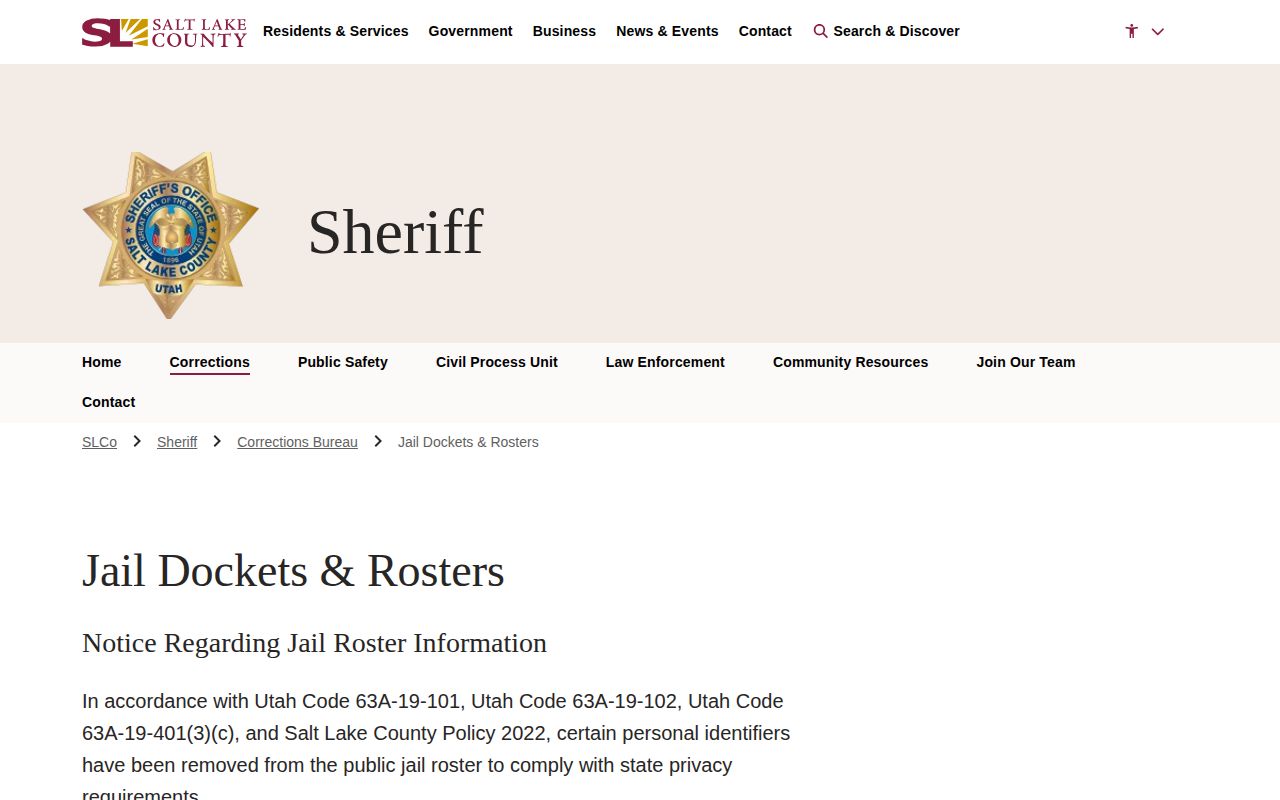
The dated cards are useful for movement research, while the Roster remains a current-custody snapshot.
| Source | Use | Limit |
|---|---|---|
| Jail In/Out Docket | Recent daily movement | Exact visible columns must be read from that PDF |
| Roster | Current daily bed snapshot | Absence does not prove release |
| Jail Dashboard | Daily population context | Misses some quick book-and-release events |
| Sheriff release report | Exact authority, time, and destination | Requires a targeted written request when not online |
UDC Salt Lake Release Search
The UDC Offender Search accepts first and last name, with an optional middle name, or a UDC offender number. Name results identify the offender number, name, date of birth, and a route to more information. The detail can show Location, Housing Facility, Release Date/Type, case manager, and email. Read these fields together.
UDC limits the public lookup to people currently under its supervision, including prison, probation, and parole. A parolee may remain visible after leaving secure prison because supervision continues. A completely discharged person may disappear. Therefore, no result is not a discharge certificate. For an older state event, search Board decisions and the court case, then request the formal UDC or Board record.
| Search field | Use | Interpretation |
|---|---|---|
| First and last name | Public name search | Compare date of birth and offender number |
| UDC offender number | Direct identifier search | Best when the official number is known |
| Location and Housing Facility | Shows operational placement | Can distinguish prison, center, or community status |
| Release Date/Type | UDC's exact public label | Read with Board action and present supervision |
| Case manager | Indicates current supervision contact | Does not mean the sentence is fully discharged |
Salt Lake Supervised Releases
Salt Lake County contains four UDC community correctional centers. Atherton serves men on probation or parole who have mental-health concerns. Bonneville holds male parolees in structured transition. Fortitude can receive male parolees, including some people leaving prison without an approved placement. Orange Street serves women transitioning on parole. A move from secure prison to any of these centers is a release from prison into controlled placement, not final discharge.
Use the UDC detail and Adult Probation and Parole to verify what happens after a resident leaves a center. The Salt Lake County parole and probation record path explains how a Board order, UDC location, and Region 3 supervision fit together. A displayed case manager or community address signals that post-release duties may still be active.
Salt Lake State Release Transport
UDC processes most releases and paroles on Tuesday at Utah State Correctional Facility. It says almost all UDC inmates temporarily housed in county jails also pass through USCF release processing. A person assigned to a community correctional center is transported there by UDC. Someone without a ride may receive case-by-case transport to a nearby UTA TRAX station and is released last.
Those state procedures do not apply to ordinary Metro or Oxbow bond releases. A Salt Lake County jail docket can show a movement into UDC custody before the later state release is complete. The UDC release-day instructions should be paired with the Board order and a post-effective-date UDC status when timing matters.
Salt Lake Release Property
County jail property and USCF property use separate procedures. The Sheriff permits a third-party property release once in six months. The requester goes to Jail Administration between 8 a.m. and 8 p.m., completes the form, shows government identification, and can expect pickup roughly 48 hours later. Jail Administration can also obtain certain signatures, often with documents available about 24 hours later.
USCF uses an appointment-based weekday property channel with its own identification rules and phone numbers. Neither process should be described as an automatic item handoff on release day. The correct route depends on whether the property remains with Salt Lake County or UDC after the person leaves custody.
Salt Lake Release Court Records
Utah Xchange can preserve charges, pleas, dispositions, judgments, and chronological case entries after a jail roster entry disappears. It supports searches using such fields as jurisdiction, case number, name, case type, county or court, filing date, and disposition date. A dismissal or sentence order can explain why release was authorized, but it is not automatically the physical-release timestamp.
Coverage differs by court. Salt Lake City CORIS coverage is listed as complete from December 8, 1997, while West Jordan begins in June 2005. Older justice-court material can be incomplete. Search the proper court and ask the filing clerk about old cases or corrections. MyCase serves parties and qualifying victims with verified access; it is not a public name-search substitute.
Salt Lake Release Expungement
Utah's petition-based expungement timing can run from the latest of case completion, jail or prison release, or the end of probation or parole. That makes both the physical release record and the later supervision-termination record important. When expungement is granted, the public Xchange case no longer appears, although specified government access can remain.
Independent publishers do not automatically erase old copies when a court record is expunged. Utah's publish-for-pay booking-photo law supplies a general removal process and a faster seven-day, no-fee route when qualifying proof shows acquittal, non-prosecution, expungement, vacation, or pardon. Booking photos themselves are protected under current GRAMA rules unless an exception applies, so the Sheriff must decide whether a requested image is releasable.
Salt Lake ICE Releases
The Sheriff states that it does not participate in 287(g), decide immigration status, or arrest a person based on immigration status. Its ICE dashboard reports aggregate jail interactions, including some releases into ICE custody. An individual outgoing event marked for ICE is a custodial handoff. It is not proof of community release.
Use the Sheriff booking/release report to confirm the first transfer and ICE ODLS for the next custody layer. ICE says its locator covers current detainees and certain people released from ICE custody during the last 60 days. A blank result after that window proves little. Federal sentenced prisoners instead use the BOP locator, while older federal pretrial custody may require the court docket and a USMS records request.
Salt Lake Jail Release Changes
Oxbow was completed in 1991, and Metro opened in 2000. A 2025 county audit reported about $42.8 million in deferred maintenance across both sites, divided between roughly $27 million at Metro and $15.8 million at Oxbow. After a proposed public-safety bond failed, the County funded 184 added Oxbow beds and freed 64 Metro beds by ending a state competency-restoration contract.
Those operational changes explain why capacity and use can shift between the two jails. They do not create separate release archives. Both facilities remain in the centralized Sheriff docket, roster, telephone, and GRAMA system. The individual release path still depends on the specific outgoing movement and destination.
Salt Lake Release Source Match
Match the source to the custody event before drawing a conclusion. A current roster can confirm a bed snapshot. A daily docket can show movement. UDC can show current state supervision. Board and court records can preserve legal action, and BOP can show a historical federal release date. VINE is valuable for notice but remains a notification layer.
| Person or event | First source | Confirmation route |
|---|---|---|
| Recent Metro or Oxbow exit | Jail In/Out Docket | Sheriff booking/release report |
| Still in county jail | Current Roster | Sheriff custody information |
| State prisoner released to parole | UDC detail and Board decision | AP&P or formal UDC record |
| Fully discharged state person | Board and court history | UDC/Board records request |
| Federal prisoner | BOP Inmate Locator | Federal docket or agency record |
| Immigration transfer or recent release | ICE ODLS | Sheriff report and ICE contact |
Can one source confirm every Salt Lake County release? No. County jail, state prison, federal custody, immigration custody, and community supervision are separate record systems. Follow the person from the releasing agency to any receiving agency.
Salt Lake Release Facilities
Seven local facilities have distinct release meanings. Metro and Oxbow are county jails with centralized Sheriff records. USCF is Utah's state release site. Atherton, Bonneville, Fortitude, and Orange Street are UDC community correctional centers where residential departure may occur while supervision continues.
- Salt Lake County Metro Jail: county custody may end in community release or an agency handoff.
- Oxbow Jail Facility: uses the same Sheriff daily docket and GRAMA route as Metro.
- Utah State Correctional Facility: processes most UDC releases and paroles on Tuesday.
- Atherton Community Treatment Center: a structured placement for men on probation or parole with mental-health concerns.
- Bonneville Community Correctional Center: a transition center for male parolees.
- Fortitude Treatment Center: can receive male parolees who need an approved placement.
- Orange Street Community Correctional Center: a transitional parole center for women.
Note: No BOP prison or official ICE detention facility in Salt Lake County was confirmed, so no unsupported local facility page was created.